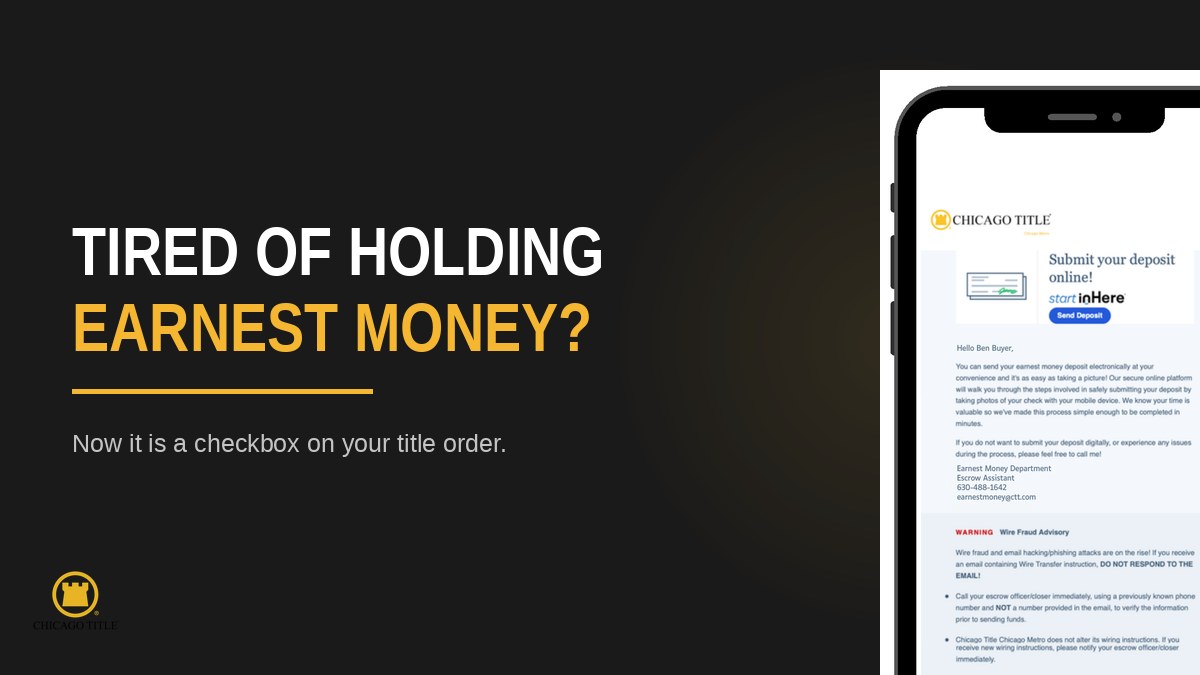
If you are ordering title through Castle Connect, you can now hand off the earnest money in the same motion. One checkbox while you are already placing the order.
We already hold earnest money for a lot of attorneys and realtors across Chicagoland. That part is not new. What changed is where you order it.
I sat through the demo before release. Here is what it actually looks like on your screen, and what the buyer sees on theirs.
What changed in Castle Connect?
When you place a title order, there is now a checkbox:
Select this option if you would like Chicago Title to send the buyer their earnest money deposit instructions now. Not ready? Uncheck it to submit later.
Check it and Castle Connect creates an earnest money order alongside your title order. You get two numbers back when you finish: your title order number, and a separate earnest money order number. That is it.
You need two pieces of information for it to work: the buyer’s email address and phone number. If you already entered those while placing the order, the earnest money section stays collapsed and you will not notice any extra steps at all. If they are missing, Castle Connect will ask for the email before it lets you submit.
Not ready to send anything to the buyer yet? Uncheck the box. The order goes through exactly the way it always has and nothing goes out.
What if you already placed the order?
You are not stuck. Open the order in Castle Connect, go to the order details, and choose Create EMD Order on the left side.
It asks for the earnest money amount, then the buyer’s contact information. Anything already sitting on the title order carries over, so most of the time you are confirming rather than typing. You can edit it before you submit.
What does the buyer see?
An email from earnestmoney@ctt.com.
It takes them to Start inHere, our platform at start.inhere.com. They verify their phone number, and once they do, they get the options for sending their deposit.
The email itself carries a wire fraud advisory, which matters more than it sounds. Buyers who have been told once, in writing, not to trust wiring instructions that arrive by email are meaningfully harder to defraud later. I have written before about how wire fraud actually reaches a closing table.
How can the buyer send the money?
Four ways, all through the same platform.
| Method | How it works | Worth knowing |
|---|---|---|
| ACH through Payload | Online payment platform, funds transmitted by ACH | $15 transaction fee, subject to change. Funds are non refundable for 5 days from receipt. Earnest money only, not closing funds |
| Mobile deposit | startSafe Mobile Deposit. Photograph the front and back of a check from a phone | About as involved as depositing a check with a banking app |
| Physical check | Bring it to any Chicago Title office | Office list at ctcastleconnect.com/locations |
| Wire | Email any Chicago Title office or earnestmoney@ctt.com to request instructions | Verify by phone using a number you already have, not one from an email |
One note on timing
ACH funds are non refundable for 5 days from receipt. That is a real constraint, not fine print. If the deposit is going out by ACH, start it when the contract is signed rather than the afternoon before closing. If the timing is tight, mobile deposit or a wire moves faster.
What this does not change
It does not change who holds the money or how it is held. We were already holding earnest money for attorneys and realtors across Chicagoland, and the escrow side is identical. What changed is that you can order it from the title order now.
One practical note: the earnest money feature has to be enabled on your Castle Connect login. If you place a title order and do not see the checkbox, that is why, and it is a quick fix.
What earnest money is, and why the escrowee matters
Worth stepping back for a second, because the choice of who holds the money is made earlier than most people realize and it is easy to default into.
Earnest money is the buyer’s deposit showing they intend to perform. National guides like to quote it as a percentage, but Illinois practitioners tend to talk in dollars. The Chicago Bar Association describes brokers using one percent as a starting point, and Chicagoland attorneys commonly see figures in the low thousands. It sometimes arrives in two pieces: an initial amount, then additional earnest money due by a later date set in the contract. Paragraph 3(b) has a separate line for that additional deposit, though plenty of deals use a single number.
The Multi-Board Residential Real Estate Contract 8.0, approved in February 2025 and the version in use since 7.0 sunset that March, handles it in Paragraph 3(b). The earnest money is tendered to the Escrowee on or before a set number of business days after the Date of Acceptance, with any additional earnest money due by its own date. The form gives three choices for who the Escrowee is: the seller’s brokerage, the buyer’s brokerage, or as otherwise agreed by the parties. That third option is where a title company comes in.
Two contingency windows matter most, and they run at the same time rather than one after the other. Attorney review is Paragraph 13, five business days after the Date of Acceptance. The inspection notice deadline under Paragraph 15 is also five business days after the Date of Acceptance, ten calendar days for a lead based paint inspection. Same trigger, same clock.
Neither one is a free look. Paragraph 13 says an attorney’s disapproval cannot be based solely on the purchase price, and a proposal to modify cannot by itself void the contract. Paragraph 15 is built around major component defects with a repair and resolution structure, not buyer’s remorse. A buyer who terminates properly inside those windows is entitled to the deposit back. A buyer who walks later, with no contingency to stand on, is the buyer a seller has a real argument against.
Note the word entitled. Being entitled to the money and having the money in hand are two different things, which is the next section.
What happens when the parties fight over it?
This is the part worth understanding before you need it.
Under Paragraph 27, whenever the contract is null and void or terminated, the earnest money is refunded on the joint written direction of both parties to the Escrowee, or on an order from a court. Those are the two keys. One party’s certainty that they are owed the money is not one of them.
If neither arrives, what the Escrowee can do next depends on who the Escrowee is, and this is the part 8.0 changed.
Under 7.0, the Escrowee gave the parties 14 days written notice of an intended disbursement, and that applied to whoever was holding. Under 8.0, that route belongs to brokerages only. Paragraph 27(a) opens with the condition that the Escrowee is a licensed Illinois real estate brokerage. If a title company is holding the money, 27(a) is not available. The remaining path is 27(b), interpleader.
So when we hold the earnest money, there is no quiet unilateral release after a notice period. It moves when both sides sign, or when a judge says so.
The strict joint order escrow that these usually sit in works the same way. Standard Illinois strict joint order instructions surrender the funds only on an order signed by both parties, and if a dispute runs 30 days past a written demand to resolve it, the escrow trustee may interplead.
Two details worth making sure a client hears before they dig in.
First, the costs of an interpleader are reimbursed to the escrowee out of the deposited funds. The disputed earnest money pays for the fight over the disputed earnest money.
Second, and this is the one people do not expect: Paragraph 27(b) provides that if the escrowed amount is not enough to cover those costs and fees, the buyer and seller jointly and severally indemnify the Escrowee for the rest. On a modest deposit, a stubborn disagreement does not just eat the money. It can cost both sides more than the money.
Which is a long way of saying the boring outcome is the good one.
Two ways to use it
Order it alongside the title order when you have the buyer’s email and phone, or add it to the file afterward from the order details. Either way the earnest money is handled inside Castle Connect, on an order you already have open.
We hold the funds, the buyer gets four ways to send them, and the deposit stays off your desk and out of your trust or escrow account.
If you want to walk through it on a live file, or you are not sure whether your login has it turned on, let’s talk.
Frequently asked questions
How do you order earnest money holding in Castle Connect? When you place your title order, check the box that reads: Select this option if you would like Chicago Title to send the buyer their earnest money deposit instructions now. Not ready? Uncheck it to submit later. Checking it creates an earnest money order alongside your title order. You need the buyer’s email address and phone number.
Can you add earnest money to a title order you already placed? Yes. Open the order details in Castle Connect and choose Create EMD Order on the left side. Enter the earnest money amount and confirm the buyer’s contact information. Anything already on the title order carries over, and you can edit it before submitting.
What does the buyer actually receive? An email from earnestmoney@ctt.com that takes them to Chicago Title’s Start inHere platform at start.inhere.com. They verify their phone number, and once they do, they are given the options for sending earnest money.
What are the ways a buyer can deposit earnest money with Chicago Title? Four. ACH through Payload, a physical check at any Chicago Title office, mobile deposit by photographing a check with a phone, or wire.
Is there a fee to deposit earnest money by ACH? Payload charges a $15 transaction fee, subject to change. The other three methods do not carry a Payload fee. ACH funds are non refundable for 5 days from receipt, so it is worth starting early.
Can a buyer send closing funds through the earnest money portal? No. The Payload portal is for earnest money only. Final closing funds do not go through it.
What information do you need before you can order earnest money? The buyer’s email address and phone number. If you already entered them on the title order, you will not notice any extra steps.
What if you are not ready to send deposit instructions yet? Uncheck the box and place the title order as you always have. Nothing goes out to the buyer, and you can add the earnest money order later from the order details.
Who holds earnest money in an Illinois residential deal? Paragraph 3(b) of the Multi-Board Residential Real Estate Contract 8.0 gives three choices for Escrowee: the seller’s brokerage, the buyer’s brokerage, or as otherwise agreed by the parties. That third option is how a title company ends up holding it.
When can a seller keep the earnest money in Illinois? When the buyer fails to perform without a contingency to stand on. Attorney review under Paragraph 13 and the inspection notice deadline under Paragraph 15 both run five business days after the Date of Acceptance, concurrently. Neither is a free look. A buyer who terminates properly inside those windows is entitled to the deposit, though the refund itself still runs through Paragraph 27.
What happens if the buyer and seller disagree about it? Under Paragraph 27, the money moves on the joint written direction of both parties or on a court order. If neither arrives, the 14 day notice of intended disbursement in 27(a) is available only when the Escrowee is a licensed Illinois real estate brokerage. When a title company holds the funds, the route is 27(b), interpleader. Costs come out of the deposited funds, and if those are not enough, buyer and seller jointly and severally indemnify the escrowee for the rest.
Sources
- Multi-Board Residential Real Estate Contract 8.0, Chicago Association of REALTORS
- Chicago Association of REALTORS, new and upcoming forms and contracts for 2025
- Illinois State Bar Association, Handling Earnest Money and Escrow Holdbacks
- Chicago Bar Association, The importance of earnest money in real estate transactions
Details are current as of September 2026. Fees and platform features change, so confirm current specifics with your Chicago Title office. This is general information about how the service works, not legal or escrow advice for your transaction.